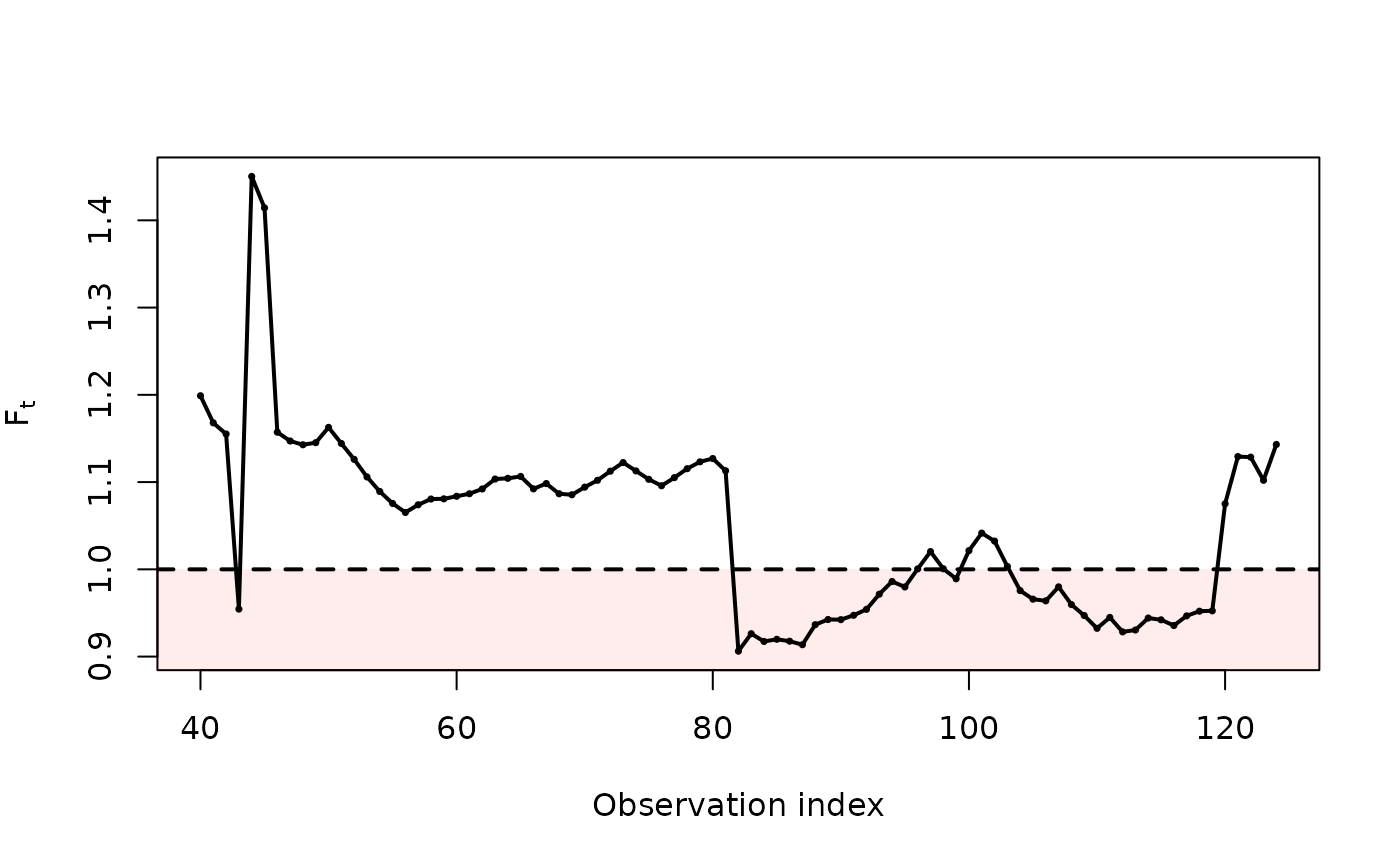
The index \(F_t\) of evbs_monitor, computed with the GEV
regression of gevreg.fit in place of the EVBS model. At each
\(t \ge\) burn the model is fitted to the first \(t\) records,
the observation with the largest mean aggregate contribution
(cnc_diagnostics_gev(fit)$Bbar) is deleted, the model is refitted,
and the endpoint \(\mu(x) - \sigma/\xi\) of the refit, evaluated at the
covariate value of the running maximum, is divided by the running maximum.
The endpoint is infinite, and so is the index, when the refitted
\(\xi\) is not negative.
Usage
gev_monitor(X, y, burn = 40, use = c("curvature", "max"))
Arguments
- X
Design matrix (including the intercept column). Centre the
covariates: the GEV likelihood is poorly conditioned otherwise.
- y
Response vector, in time order.
- burn
Number of initial observations before the index is first computed.
- use
Either "curvature" (default) or "max".
Value
A data frame of class evbs_monitor with the time index, the
running maximum, the flagged observation, the fitted shape parameter
xi, the endpoint and the index F. Instants at which a fit
fails or does not converge are omitted.
Examples
# \donttest{
data(itajai)
X <- cbind(1, itajai$pressure - mean(itajai$pressure))
gt <- gev_monitor(X, itajai$wind, burn = 40)
plot(gt)
 # }