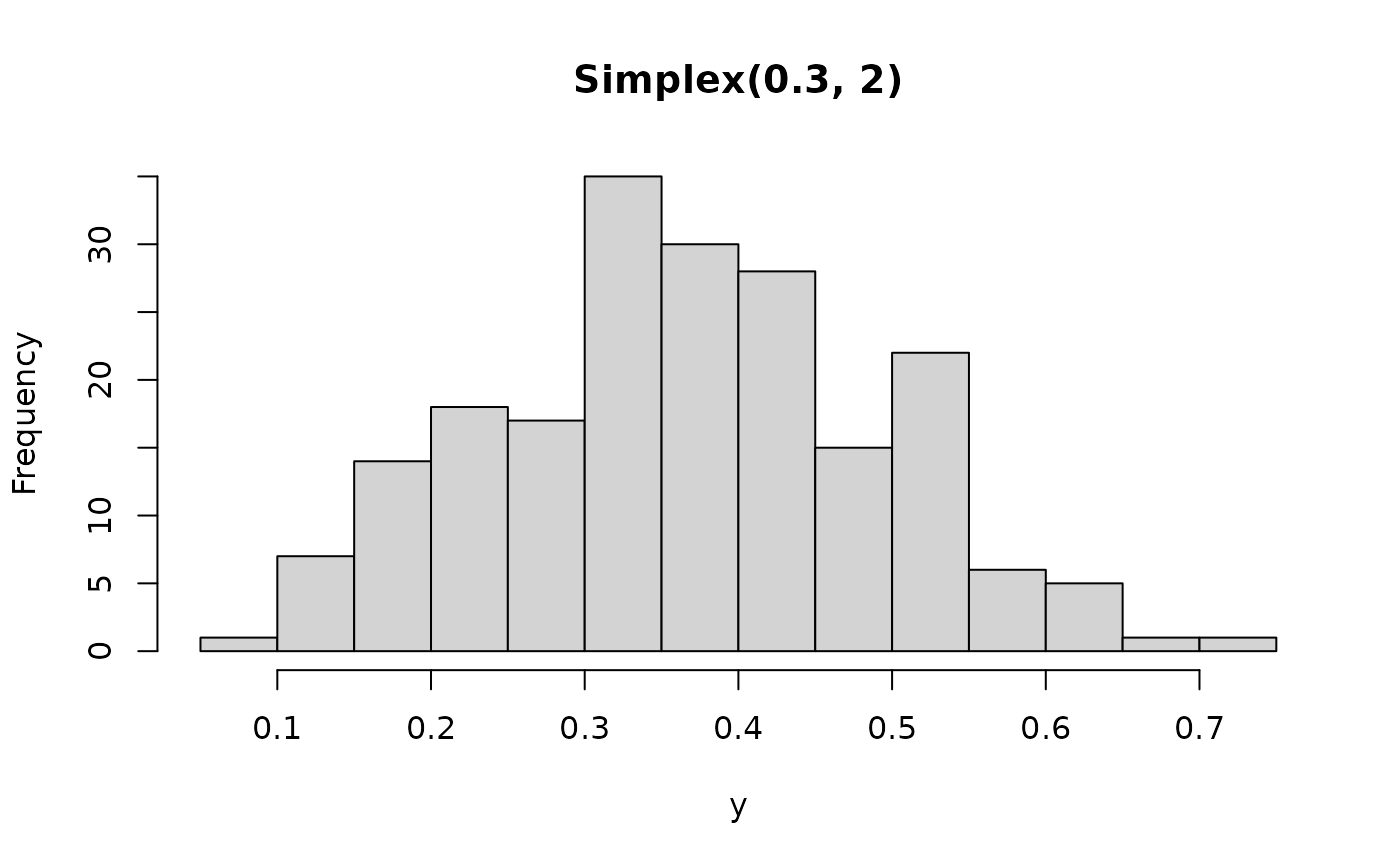
Generates independent observations from a simplex distribution \(S^{-1}(\mu, \sigma^2)\) using the representation via inverse-Gaussian and chi-squared random variables (Michael, Schucany & Haas, 1976).
Details
Uses the reparametrisation \(\epsilon = \mu/(1-\mu)\) (odds) and \(\tau = \sigma^2 (1-\mu)^2\) to generate from an inverse-Gaussian mixture. Identical algorithm to the Ox reference implementation.
References
Barndorff-Nielsen O.E., Jorgensen B. (1991). Some parametric models on the simplex. Journal of Multivariate Analysis, 39(1), 106–116.
Michael J.R., Schucany W.R., Haas R.W. (1976). Generating random variates using transformations with multiple roots. The American Statistician, 30(2), 88–90.