
The ammonia application
This article reproduces the ammonia-oxidation application from the
companion methodological paper (Ospina, Espinheira, Silva and Barros,
2026), using the ammonia dataset (Brownlee, 1965;
).
The model fitted in the paper has
for the mean, and
for the dispersion, where
= corr_ar (air flow) and
= temp_agua (cooling water inlet temperature).
One-call reproduction
The function paper_ammonia() fits this model, runs the
bootstrap GoF test, and produces the diagnostic plots from the paper in
a single call. We use B = 50 bootstrap replicates here for
speed; the paper uses B = 1000.
res <- paper_ammonia(B = 50, seed = 123, plot = TRUE, verbose = FALSE)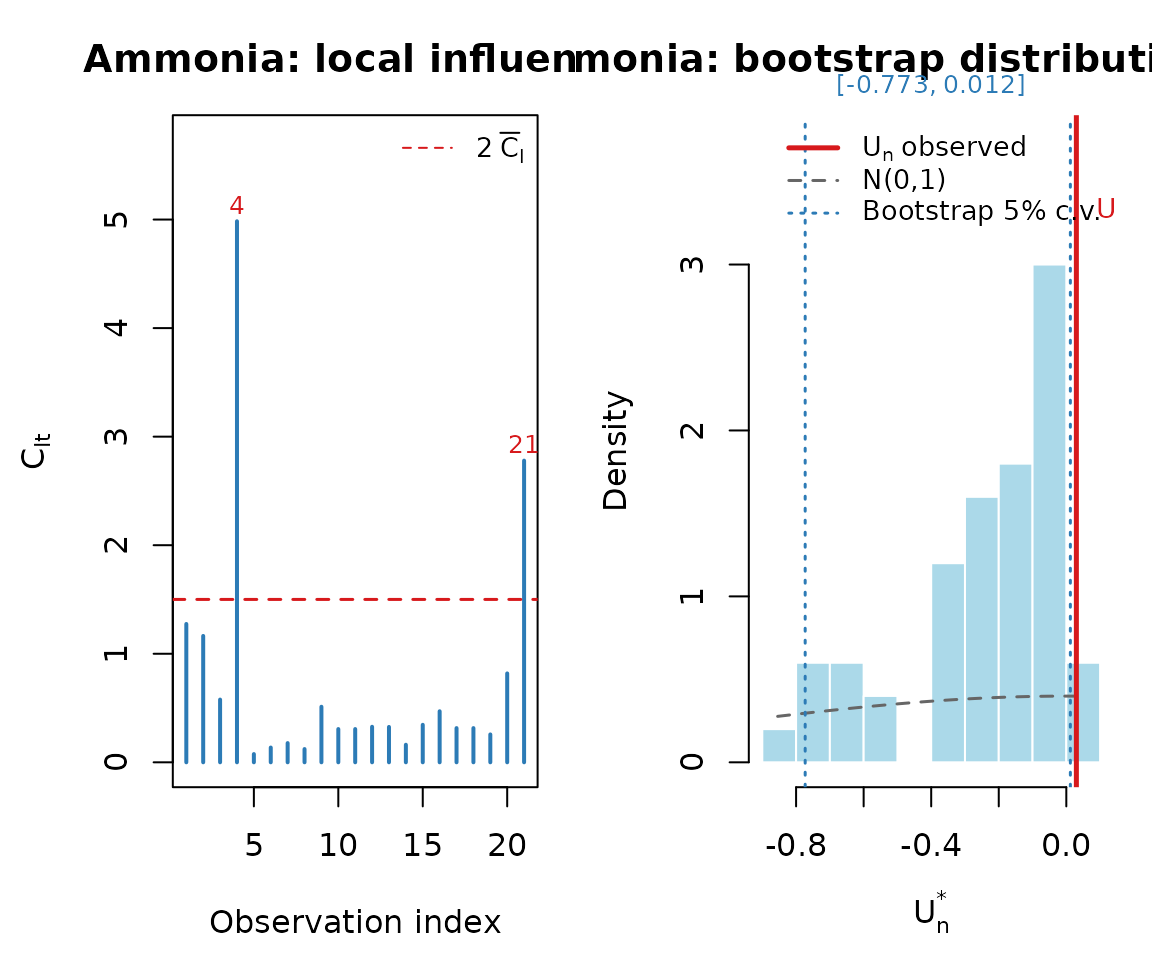
Parameter estimates (Table 5 of the paper)
print(res$table_params, row.names = FALSE)
#>  Parameter  Sub_model Estimate Std_Error z_value p_value
#>      beta1       Mean -12.9893    2.1038 -6.1742 < 0.001
#>      beta2       Mean   0.1312    0.0363  3.6140 < 0.001
#>      beta3       Mean   0.2705    0.1024  2.6408 0.00827
#>      beta4       Mean  -0.0037    0.0017 -2.1473 0.03177
#>     gamma1 Dispersion   3.8342    3.3908  1.1308 0.25815
#>     gamma2 Dispersion  -0.4454    0.2882 -1.5456 0.12219
#>     gamma3 Dispersion   0.0044    0.0024  1.8791 0.06024
Goodness-of-fit results (Table 6 of the paper)
print(res$table_gof, row.names = FALSE)
#>      Un alpha Boot_lo Boot_hi Decision_boot Norm_lo Norm_hi    Decision_norm
#>  0.0298    1% -0.8371  0.0255     Reject H0 -2.5758  2.5758 Do not reject H0
#>  0.0298    5% -0.7731  0.0120     Reject H0 -1.9600  1.9600 Do not reject H0
#>  0.0298   10% -0.7330 -0.0010     Reject H0 -1.6449  1.6449 Do not reject H0
Step by step
The same analysis can be reproduced manually with the lower-level functions of the package:
data(ammonia)

X <- cbind(1, ammonia$corr_ar, ammonia$temp_agua,
           ammonia$corr_ar * ammonia$temp_agua)
Z <- cbind(1, ammonia$temp_agua,
           ammonia$corr_ar * ammonia$temp_agua)

fit <- simplex_fit(ammonia$perda, X, Z)
fit
#>
#> Simplex Regression  (n = 21 ; p = 4 ; q = 3 )
#>
#>        Estimate Std.Error z.value      Pr
#> beta1  -12.9893    2.1038 -6.1742 < 0.001
#> beta2    0.1312    0.0363  3.6140 < 0.001
#> beta3    0.2705    0.1024  2.6408 0.00827
#> beta4   -0.0037    0.0017 -2.1473 0.03177
#> gamma1   3.8342    3.3908  1.1308 0.25815
#> gamma2  -0.4454    0.2882 -1.5456 0.12219
#> gamma3   0.0044    0.0024  1.8791 0.06024
#>
#> Log-likelihood: 100.4159  |  converged: TRUE

dg <- simplex_diag(fit)
dg$Tn
#> [1] 8.044735
dg$Un
#> [1] 0.02977546
plot_influence(dg)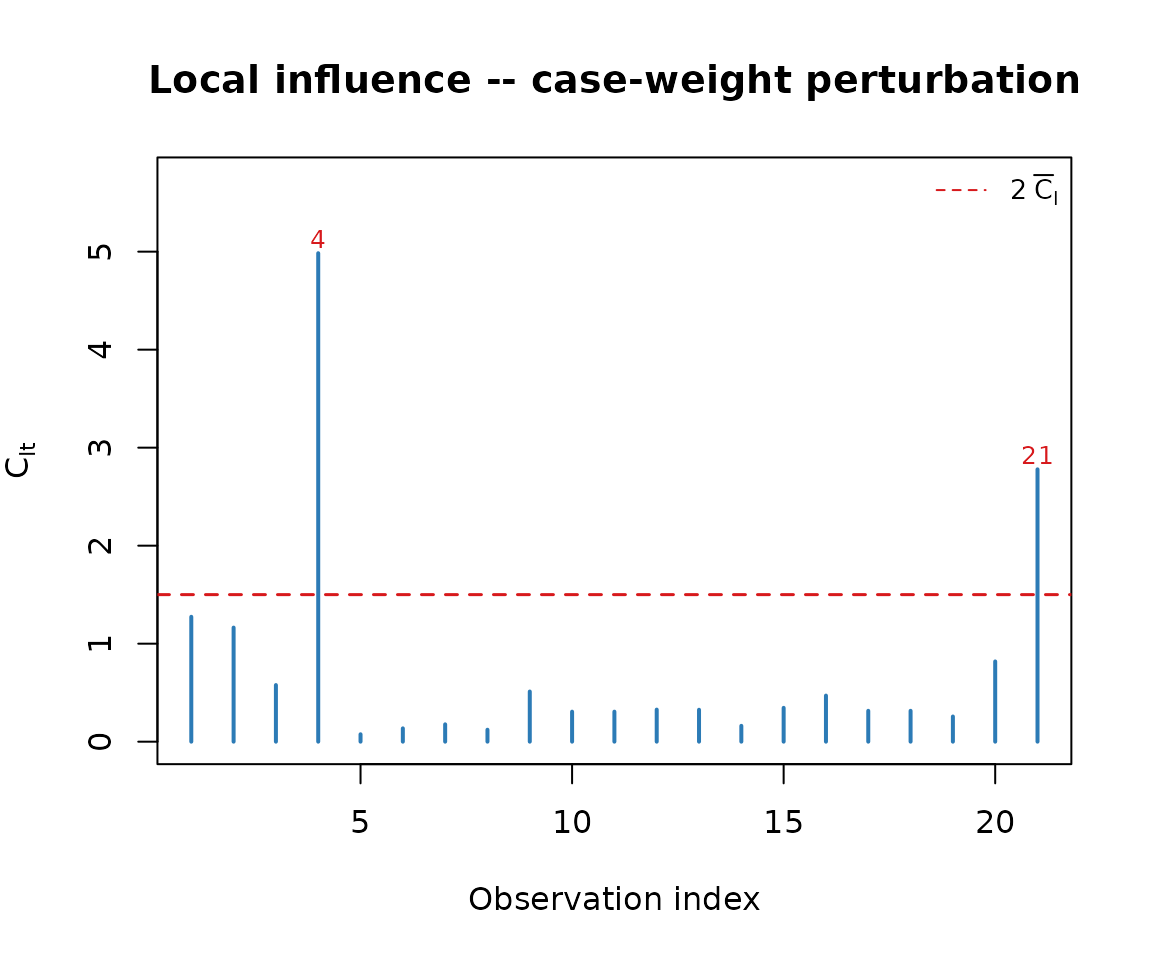
set.seed(123)
gof <- simplex_gof(ammonia$perda, X, Z, B = 50, verbose = FALSE)
gof
#> simplexgof: U_n = 0.0298  (Tn = 8.0447, B = 50)
#>
#>  alpha boot_lo boot_hi decision_boot norm_lo norm_hi    decision_norm
#>     1% -0.8371  0.0255     Reject H0 -2.5758  2.5758 Do not reject H0
#>     5% -0.7731  0.0120     Reject H0 -1.9600  1.9600 Do not reject H0
#>    10% -0.7330 -0.0010     Reject H0 -1.6449  1.6449 Do not reject H0
plot_gof_boot(gof)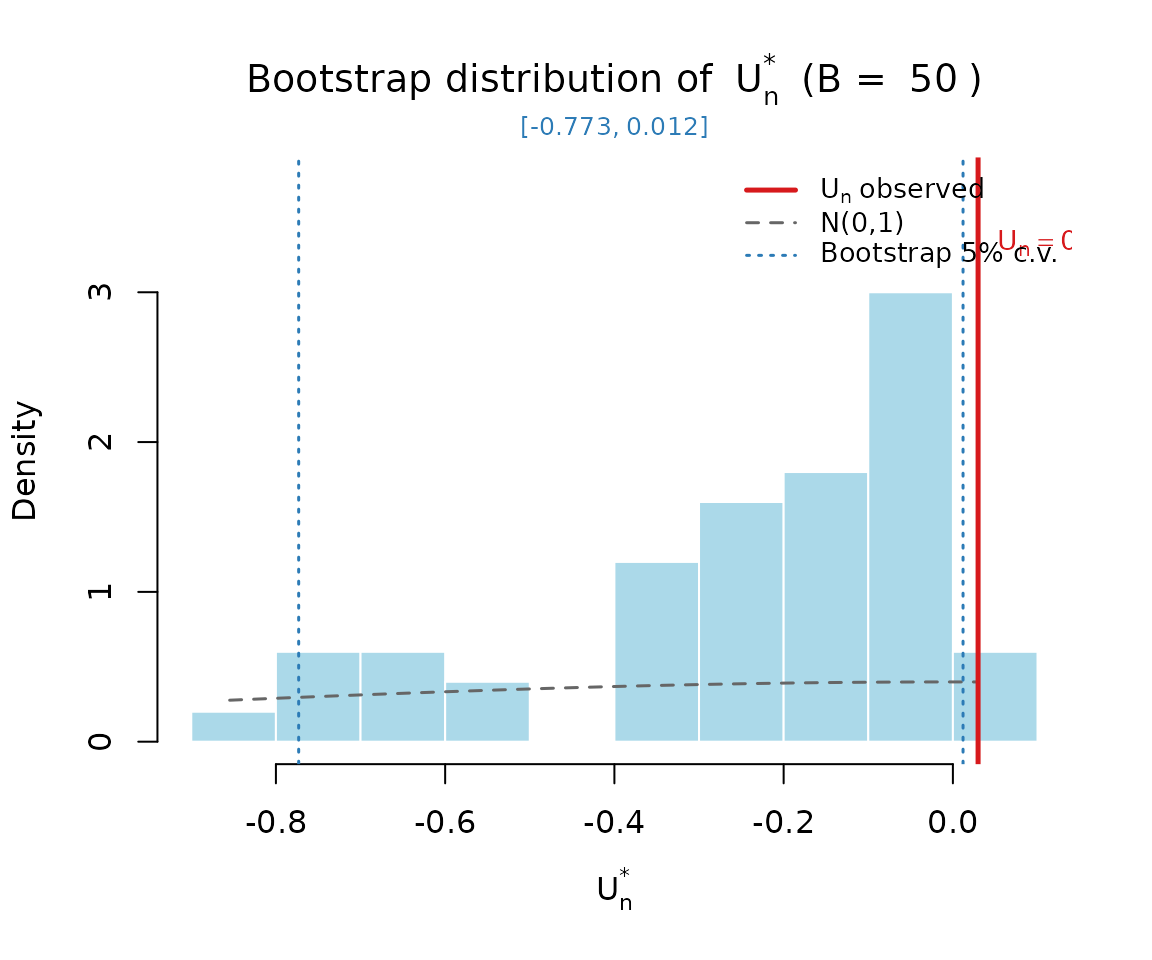
As reported in the paper, the test does not reject at conventional significance levels for this model, consistent with an adequate fit.